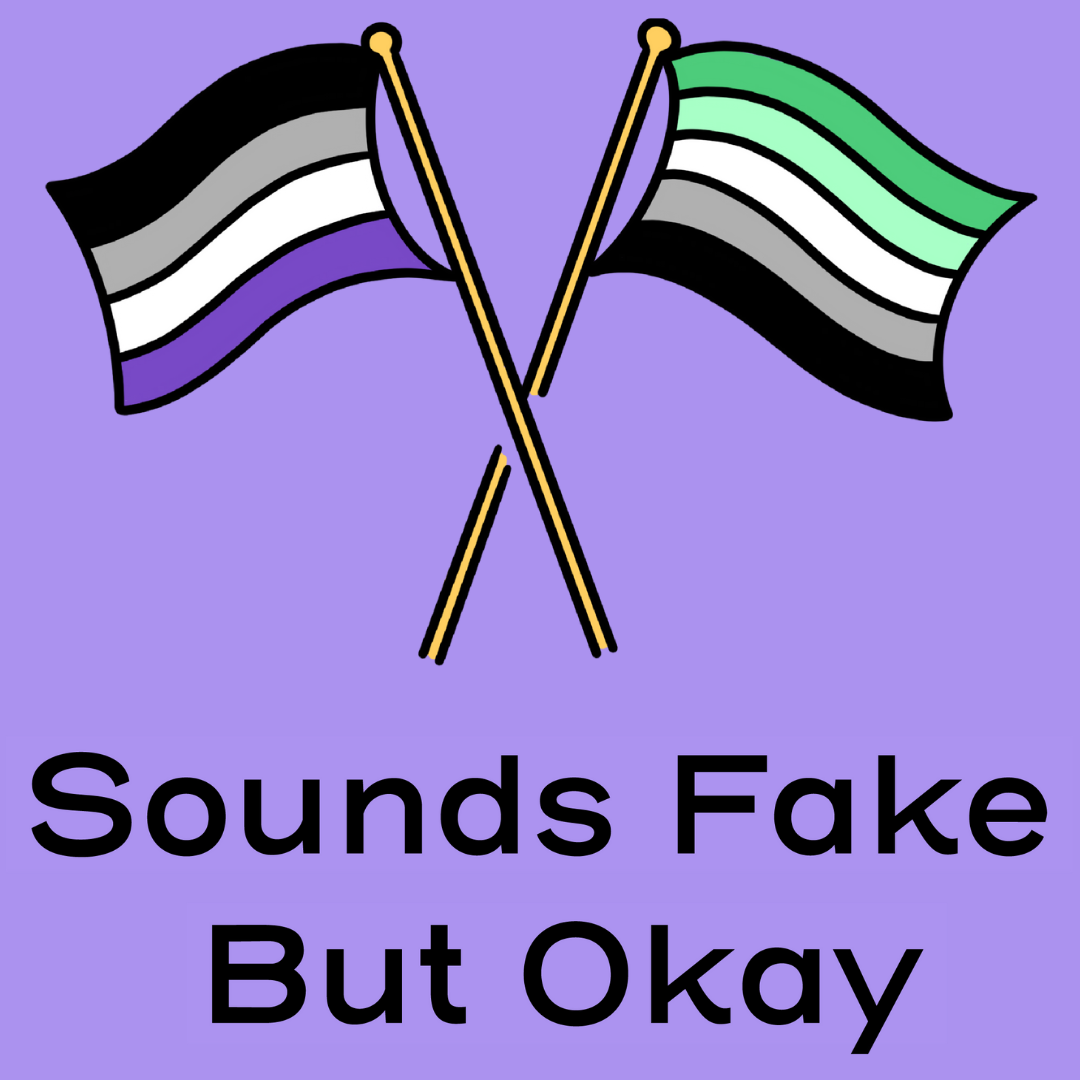
Ep 373: Aplatonic
SARAH: Hey, what's up? Hello! Welcome to Sounds Fake But Okay, a podcast where an aro-ace girl (I'm Sarah, that's me.)
KAYLA: And a bi-demisexual girl (that's me, Kayla.)
SARAH: Talk about all things to do with love, relationships, sexuality, and pretty much anything else we just don't understand.
KAYLA: On today's episode: Aplatonic.
BOTH: Sounds fake, but okay.
SARAH: Welcome back to the pod.
KAYLA: We are doing really well, thanks for asking.
SARAH: No one here is itchy.
KAYLA: Nope.
SARAH: No one here is depressed.
KAYLA: No.
SARAH: We're all completely itch-less and manic.
KAYLA: And… yeah, we're smooth as a baby and…
SARAH: We're so far opposite of depressed that we are in fact manic.
KAYLA: Manic, yeah. Looped all the way around, perhaps.
SARAH: Everyone here is really good.
KAYLA: What I would give to be manic right now. Anyway. No, but it's serious.
SARAH: Addie is making biscuits on my feet right now, she's trying to itch me.
KAYLA: That's nice. Earlier, Billy was…
SARAH: But if she sticks her claws in me, she will make me more itchy.
KAYLA: She will make you more itchy. Billy was making biscuits on my stomach earlier and it did kind of like move some stuff around, so that was interesting.
SARAH: Oh, cool.
KAYLA: I was like, “oh, thank you.”
SARAH: Do we have any housekeeping?
KAYLA: Next week will be a better episode.
SARAH: It will be. We have actually already recorded next week's episode, so.
KAYLA: Yeah.
SARAH: Get excited, everyone.
KAYLA: And we might even be celebrating a holiday for once.
SARAH: Oh my God.
KAYLA: So.
SARAH: We are capable of doing that? Question mark?
KAYLA: And it's not our…
SARAH: Yeah?
KAYLA: It wasn't our doing, we cannot take credit for it, you'll understand when you get there.
SARAH: Yes. Kayla?
KAYLA: Yes?
SARAH: Tell me, what are we talking about this week?
KAYLA: This week, we are talking about aplatonicism, which is something I think we've referenced every so often in the past year or so. I don't think I knew about it much before a year or so ago, but this time we're going to do a whole episode on it. I don't know that either of us could claim anywhere near to be experts on this, this is more of a discovery we're going on together.
SARAH: This is an exploration.
KAYLA: But we have done some reading, and so, yes.
SARAH: Yes, we both can read.
KAYLA: We can read.
SARAH: All right. Let's start simply. Your Honor?
KAYLA: Yes.
SARAH: What is aplatonicism?
KAYLA: Aplatonicism is… I'm going to go for a… which website shall I choose?
SARAH: Ooh.
KAYLA: Ooh. There's a website called aplatonicinformation.com that I found quite useful, and I will read to you what they have to say.
SARAH: Yippee.
KAYLA: Aplatonic, commonly shortened to apl, I believe it's just the letters.
SARAH: Just apl, not apple. Wait, there’s an apple
KAYLA: Oh, you know what? I think it is apple because I've seen the apple a lot on the flag and in pictures, so I bet it is apple. Okay, I'll start over then.
SARAH: I don't know about that.
KAYLA: I assumed so.
SARAH: Okay.
KAYLA: Aplatonic, commonly shortened to apl, that's so funny, is an identity on the a-spectrum/anattractional spectrum defined by atypical feelings towards platonic attraction, platonic love, or platonic relationships. There have been multiple definitions of aplatonic throughout its history. Currently, it is most commonly defined as a platonic counterpart to asexual/aromantic: Experiencing little to no platonic attraction, and/or experiencing platonic attraction in an atypical way. Other definitions still considered accurate by some include: struggling to form or maintain friendships due to neurodivergence and/or trauma, not relating to the concept of platonic attraction, and experiencing no desire for friendship or platonic relationships.
SARAH: So, in the same way… well, okay, in my mind, it's not exactly the same as asexual and aromantic, but it is. It's because there's multiple definitions.
KAYLA: Yeah, I mean, I think… so, from what I've read, the aplatonic was first used as a word in maybe 2012, I think is what I saw in history, in 2012 on an AVEN forum, shocking.
SARAH: Shocking
KAYLA: So, it seems as though… I mean, it's obviously still a newer community. And it seems like it's still in the stages of kind of like coming to those more solid definitions, which also like, I don't know that you ever come to a solid decision. You know, I think even in like, ace and aro communities, that's… like, terminology is still a big point that lots of people talk about.
SARAH: Yeah.
KAYLA: But the sense that I've gotten from reading through things and looking into the aplatonic Reddit and things like that is that it does feel very similar to aromantic and asexual in that thinking about like the split model of attraction with like, romantic, aesthetic, sexual, all those different types of attraction that aplatonic is just like, also one of those.
SARAH: Yes. I think for me, part of my struggle with it… I think, as I was kind of reading about it today, it kind of struck me that me trying to understand aplatonicism is a good exercise in putting myself in the shoes of allos who are trying to understand aro and ace identities.
KAYLA: I felt the same way, yeah.
SARAH: Because on paper, I understand it, but there's a part of me that is struggling to grasp what that would look like in a lived experience. Because in my mind, I don't think of platonic attraction as an attraction per se, not in the same way that romantic or sexual attractions are attractions. Like when I see someone I want to be friends with, I don't necessarily think of that as platonic attraction, even though maybe that is technically what it is. But you can also… I mean, you can become friends with someone without being like, ooh, I really want to be friends with that person. Like it can still kind of happen naturally.
KAYLA: Right. But I also think… because I kind of had the same reaction, I was… yeah, I thought the same thing of like this… on paper, I'm like, yeah, sounds great, I don't experience this, but as I do with anything, like you do you, you're not hurting anyone, like what the fuck do I care truly? Like not in like a flip it way, but in a like, do whatever the fuck you want way. But yeah, similarly, I was like, this is just not something I experienced so it's hard to wrap my mind around like what it would feel like. But I mean, I think in the same way, and a lot of these websites and people online talk about this in the same way that an aromantic person with no romantic attraction can have a romantic partner, aplatonic people can and do have friends, it just looks differently.
SARAH: Right.
KAYLA: And I don't know that I've ever put much thought into attraction being a word I would use for platonic feeling, but kind of thinking about it now, I do think that's a thing because there are definitely certain types of people who I'm more drawn to being their friend. Like even thinking back to like when I first started going back to work in person again, like thinking about which people like around me physically I was more drawn to, it's like, yeah, that's definitely like a certain type of person. Like I'm personally often more drawn to like women just because I've always grown up being around more women. I'm more likely to be attracted to be around women in like a friendship way, right?
SARAH: You're more likely to feel comfortable around them before you really know them super well.
KAYLA: Right. Like that's just what I'm attracted to because… I mean, there could be lots of reasons for that. But like in a sense that is a certain type of attraction, I guess, it's just you don't often use that word to think about friendship, I don't think.
SARAH: Yeah, I think that's fair. I think because perhaps because platonic attraction… now, this is me making an assumption about alloromantic and allosexual people that might not be true. But in my mind, because platonic attraction probably happens more often and more frequently, like you want to be friends with… I mean, obviously you can have like a crush on or want to fuck several people at once, but like just on average, I feel like the quantity of people that you might be experiencing platonic attraction to at any given time is on average, probably higher, but I don’t know if that’s true
KAYLA: I would think so, but neither of us are the right person to ask for that.
SARAH: I don't know if that's true.
KAYLA: Yeah. I guess I don't know how often the average allo is like experiencing any type of attraction.
SARAH: I would think maybe most frequent, platonic, next frequent, sexual…
KAYLA: You don't think aesthetic would be at the top?
SARAH: Oh, aesthetic, yeah.
KAYLA: Yeah.
SARAH: Aesthetic might be the top, top.
KAYLA: It's just hard to tell because it's like… it's not like every attraction is acted upon, right?
[00:10:00]
SARAH: Right.
KAYLA: Like you could be romantically attracted to like 50 people and because you're monogamous only act on like one or two of them at once.
SARAH: That doesn't mean that you're not still attracted to those.
KAYLA: But because friendship is structured differently, like it is more conventional to be friends with lots of people than it is to have lots of romantic or sexual relationships. So, it's like, it's hard to know.
SARAH: Yeah, I agree. I was looking on the same website, there's a section that's like, “are you aplatonic?” And so, it lists some common experiences.
KAYLA: Oh, this might be helpful.
SARAH: I think we should go over the common experiences.
KAYLA: Yes.
SARAH: Obviously, there's no definitive aplatonic experience, but some aplatonic/apl… apple specs?
KAYLA: That's so fun, I want to be an apple.
SARAH: I know, but it's not appletonics. So, like, it's not the same sound when you put them together
KAYLA: Aplatonics?
SARAH: Because it said aplatonic/apl specs and my brain was trying to make it say applespecs. Anyway, it doesn't matter.
KAYLA: Yeah, that’s tough.
SARAH: They have vastly different experiences, but there are some experiences that are common, some of those experiences include: feeling little to no desire to seek out or maintain friendships or feeling indifferent toward having or not having friends. Never being the one to initiate friendship. Not missing one's friends when away from them, even for long periods of time. Now that for me is just ADHD, I don't have object permanence.
KAYLA: I get that, to me is just like, if something's not right in front of me, I could love it so much with my whole life and I might just forget that it exists.
SARAH: Forget. Anyway, but I can also see how that for people who are more neurotypical than the both of us.
KAYLA: Me? What? What do you mean? What could you mean?
SARAH: Only having friendships based on logic rather than emotion. So, for example, we have the same hobbies or we have all the same classes rather than they make me happy or I love them.
KAYLA: Interesting.
SARAH: Never feeling the desire to be friends with strangers or see them again. Feeling that love is too strong of a word or feeling to ever apply to friendship. Feeling uncomfortable with being told “I love you” by friends. Finding it weird and perhaps uncomfortable how quickly and easily people consider you a friend. Feeling overwhelmed or uncomfortable with having too many friends or with friends wanting to be closer to you. Never feeling lonely, if only. Strongly preferring to spend time alone rather than with friends. Prioritizing other types of relationships over friendships with few or no exceptions. Having a very low social battery for friends. And if you're also aromantic, feeling alienated from most of the aromantic community due to the emphasis on friendship.
KAYLA: I will say that is a big one that I've seen from what I've been reading is like the big… a huge frustration I've seen people express in aplatonic spaces is that aspec spaces, especially aro spaces, emphasize friendship so much in the same way that asexual people will sometimes be caught being like, “well, we're not freaks, we feel romantic love.” And then it transfers to aromantic people being like, “oh, we're not loveless robots, we have friends.” Where it's like, okay, I see the point you're trying to make, however, not the most helpful or inclusive way to make that point.
SARAH: Yeah. I've seen it referred to as platonormativity.
KAYLA: Yes, which I think is a fun and useful word.
SARAH: And I'm just saying this is actually on the r/aromantic reddit. But this person says, “I'm telling you this as an aplatonic person, you may not realize it, but platonic attraction has a lot more common points with romantic attraction than you seem to think. When I hear alloplatonic people talking about platonic attraction, it sounds exactly like an alloromantic person talking about their crush, the only difference is what you want to do with them. So frankly, why you all act as if platonic relationships are necessarily better than romantic ones is a mystery to me. Seriously, they work exactly the same, you see someone, want to know them more and end up developing feelings or not, the only difference is the nature of the feelings.” Which when I first read that, I'm like, you don't have feelings for platonic friend, but I can also see stepping away from that, just looking on paper, like imagining myself as someone who is aplatonic or someone who is just like from an entirely other planet with an entirely different system like observing humans for the first time.
KAYLA: Yeah, it is similar.
SARAH: It is quite similar.
KAYLA: Yeah, in that way of, like they said, “you see someone, you know them a little bit, and then you have the urge to know them more.” To me, that explanation does a lot for me in understanding platonic feelings as an attraction, because again going… the biggest instance I can think of was when I met a large group of new people, is again, when I went back to work in person for the first time in a long time. And there were people who right away, after only a day or so, I was like, these are going to be my people at work. And these are people who I'm friendly with, but I don't feel the need to necessarily go out of my way to get to know them even better.
SARAH: Or people who you're friends with, but really only in group settings, like you would never do something when only with them.
KAYLA: Right, and that does come down to a certain type of attraction to those kind of people for whatever reason of like, I only knew these people for a couple of days. And of course, there's people that I've since gotten to know better that I maybe originally didn't think I was going to get along with, and now I'm great friends with, whatever, there's always things like that. But I very quickly… I mean, think about when you and I became friends, like, it was very quickly like, oh, this is going to work. But it could have very easily been like we met each other and we were like, “mm, no.”
SARAH: Right. This person then goes on to say, regarding the nature of the feelings, he said, “none of them are better or deeper, they're just different. I can get that you are mad as friendship is not recognized as it should be in the society, but saying platonic relationships are better than the others is just going to create a new norm that will, of course, leave people aside. Let's stop comparing things that there's no point in comparing, it's like saying that ice cream is better than pasta, they may both be food, but they're so different that the comparison has no value, they can both be delicious anyway, even if some people may not like one or both.”
KAYLA: Yeah, it does not seem all that helpful to me to make objective claims about what is better than the other. Obviously, for each individual person, there's going to be a value system there.
SARAH: And I can understand why aro people would place a lot of value on friendship.
KAYLA: Yeah.
SARAH: If you're aro and not aplatonic, I can see why you would lean heavily on that, as an aro not aplatonic person.
KAYLA: Yeah, and I don't think there's anything wrong with that as a personal value if you're going to go around being like, well, here's what the objective best thing is, then yeah, that's not going to be super helpful.
SARAH: As I was reading about this, I kept thinking about this in the context of the first line of our book, which is for those of you who haven't read our book or listened to our book or just forgot it's, ‘the aspec story is a love story, they all are in the end.’ And regarding that line, I think would aplatonic folks disagree with that?
KAYLA: I mean, I think some might.
SARAH: I'm sure it's a person-to-person thing, but I wonder what the general consensus might be.
KAYLA: I wonder, again, as I've been reading all these things, there's a micro-label within aplatonicism and I think it also is a micro-label used in the aro community, which is loveless or heartless, which is not feeling connected to the concept of love in any regard, whether that's romantic, platonic, any of that. So, if you're a loveless person, then yeah, you probably don't identify with that line at all.
SARAH: Right.
KAYLA: I think that the concept of love and the concept of the relationships you're having around you and the importance is really difficult, because to me, and again, this is coming from a very platonormative place, is like you need some relationships with people in some way in your life. They don't have to be close, but as a human race, we rely on other people.
SARAH: We’re a communal…
KAYLA: Like there is some level of community there, whether you engage with it deeply, in like a deep emotional fashion or not. So to me on that human level, I'm like, well, there always is some sort of love there, whether it's a deep love or more of just the like, we're all humans living on the same earth together kind of type beat.
SARAH: Right.
KAYLA: But again, that's not going to match with everyone's definition of love and is like not... you know?
SARAH: Yeah, and that brings me to the other point that I thought of as I was reading about this, in the Medium article that you sent, which is called...
KAYLA: I'll try to put all these links in the episode description, too.
SARAH: Yeah, it's called ‘Friendship is Not a Universal Language’ by Rocky Trondle. Rocky Trondle, the author themselves is not aplatonic, but they interviewed two different aplatonic folks for this little article and a quote that really stood out to me from that is, “the through line is clear, we have mistaken a common human experience for a universal one.” And I love this line, and I think it applies to a lot of things
KAYLA: Yeah
[00:20:00]
SARAH: Because it applies to asexuality, it applies aromanticism, like anything under the A umbrella is, you know, people are... They assume that just because something is common that everyone experiences it.
KAYLA: Yeah.
SARAH: But to a certain extent, in the context of aplatonicism, I still do struggle with it a bit, because I think it is human nature to seek out the things that bind us and seek out the things that make us similar to the people around us.
KAYLA: Yeah.
SARAH: And that often is vocalized in the sense of like, oh, what makes us human? And the importance of love in its many forms, all of them together, and community, as you mentioned, to me is at the core of personhood, like that is what my fundamental understanding of personhood is kind of based in. And so, I'm thinking, okay, from the lens of aplatonicism, if we can't or if we're just not going to use that to define person-dom, then I'm sitting here left with the bag wondering, like, okay, what is it to be human then, if not that? And so, then that leads me to a few questions that are probably answerable, I just didn't get deep enough in the research to get them answered. And maybe different people have different answers to this. But the two questions that I have are, where does familial love fall into this? Because I think of familial love as a type of platonic love.
KAYLA: Interesting.
SARAH: But would aplatonic folks agree with me on that? I don’t know.
KAYLA: I did see some small references, I think it was maybe in some Reddit posts to a term called afamilial, which I assume is then another A type orientation where people are not having that, like… familial attraction feels weird to say
SARAH: Yeah, attraction feels weird
KAYLA: But that kind of familial bond
SARAH: The draw, yeah. Which then that makes me question, okay, then how do you define what familial is? Is it people who are blood related to you? Is it who raised you and was raised with you? What if it's a cousin who you didn't meet until you were 15? Can you feel a familial bond with them? A lot of outstanding questions that, like, we really don't have answers to. So, then my second question that is brought up by all of this pondering is, I have to assume that there are people out there who are full send, aro, ace, and aplatonic.
KAYLA: Yeah.
SARAH: So, for those people, I am really curious and I really want to just kind of dig in their brain about what brings them fulfillment, because there are so many things that can bring you fulfillment, like reading a book. But then my question is, like, okay, if you're reading fiction, do you relate to the types of relationships that you see in fiction? Are you just not a fiction girlie? I don't know.
KAYLA: Interesting.
SARAH: I'm curious about what, like, brings you fulfillment, like, in that world. I'm curious about what your relationship with loneliness is, if any.
KAYLA: Mm.
SARAH: And most of all, I am curious about how would you define what it is to be human? Like, what would your definition be of, like, what defines persondom and humanity for you?
KAYLA: Yeah, and I don't... I want to hedge because I know that a common issue for aspecs of any type is being dehumanized.
SARAH: Yes.
KAYLA: I don't think what Sarah is trying to say is that people who do not experience platonic attraction are not human.
SARAH: No. I just want to understand what your…
KAYLA: Like philosophy is?
SARAH: Yeah, like, your understanding of the human experience, how that takes shape because of the experience that you have had as an aplatonic person.
KAYLA: Yeah, I think that's fair, because I do think you're right, that often when people are explaining, like, what makes humans different from, like, I don't know, I don't want to be, like, an animal and be like, oh, you're an animal because you're aplatonic, I don't know, I don't… you know.
SARAH: Different from… what makes us special.
KAYLA: What makes a human special is, like, that we're, you know, people are like, oh, humans are social beings. They, like…
SARAH: Have a capacity for community, to build, to help one another, all of that.
KAYLA: Yeah. Which I also don't know that, like… I mean, I think this is a problem for people that are aplatonic or not is, like, where do you draw the line between, like, this is someone I know and this is, like, an actual friend, right? Because, like, reading through the aplatonic Reddit, there are stories of people who are, like, yeah, these are people in my life that, like, they consider me a friend, but I would not call them a friend. And there are some people talking about, you know, experiences where, like, I have told people that and they've gotten offended or, like, some people are, like, okay, I don't quite understand, like, how your brain is working, but, like, I don't care. You know, they still have, like, whatever relationship dynamic that they have and it’s fine.
SARAH: Like, I still enjoy spending time with you and that's fine.
KAYLA: Yeah. So again, in the same way that an aro person can have a romantic relationship, like, an aplatonic person could have a friendship or something that from the outside would look like a friendship.
SARAH: Right. And also, something I said earlier kind of pinged this in my brain, I also don't mean to say that, like, just because you're aplatonic means that you don't care about other human beings.
KAYLA: Yeah.
SARAH: Because having platonic attraction and caring about the well-being of other humans are two entirely separate things.
KAYLA: Yeah
SARAH: And I don't want those to feel conflated at all. But yeah, I feel like if I… I really want to just kind of talk to an aplatonic person and dig around in their brain with their consent and… because I think getting answers to these questions or at least hearing their perspectives on things would help me to grasp what it is like to be aplatonic and it would help me to understand aplatonicism better on a fundamental level.
KAYLA: Yeah. Which I also think is helpful, like, even us just trying to, like, sit here and figure this out ourselves, like, I find it very eye-opening to think about friendship from an attraction way, which I think is, like, what we often say about allo people is, like, no, really, like, learning about aspec identities can help you reframe things. In the same way that we have, like, oh, the relationship escalator, this is what romantic relationships are supposed to look like, we have that I'm sure with friends too, of like we just assume that friendship is a very similar thing for everyone and that everyone is going to go about it in the same way. Which even for, like, allopla…
SARAH: Alloplatonic
KAYLA: Alloplatonic people, so many new words, even for alloplatonic people, like, not every single person is going to go through a friendship in the same way and, like, build a friendship the same way.
SARAH: There are people who you could stand in line with for 10 minutes and they're like, oh, we're friends now.
KAYLA: Yeah.
SARAH: And there are people who won't consider you a friend until you've hung out one on one. Like, even if you've seen them in group settings, they're like, oh, that's still like an acquaintance, whatever. Like, people have different definitions of what a friend is. So.
KAYLA: Yeah. But yeah, I am interested, especially for people who don't have that desire to, like, form those closer relationships or, like, that kind of dynamic of aplatonicism, I am interested to know what is your engagement like with, like, your more general community? Like, what is the line between, like, this is my community of neighbors or this is a club I go to or even, like, this is, like, an online space that I'm in. Like, where do you draw the line between, like, this is a level of community that I'm enjoying and now people are starting to treat me like I'm their friend and I'm not and I don't like this.
SARAH: There's a level of intimacy that I'm no longer comfortable with.
KAYLA: Right. Because I've seen that too, of people talking on Reddit of, like, I get really annoyed when I connect with someone on Discord or I have a conversation with someone once and they start referring to me as their friend, they're like, I don't like that because we're not friends. And I'm like, yeah, I agree with you, you probably aren't friends. Like, you just met that person, like, that is pretty wild. So yeah, I would be very interested to know, like, what that level of intimacy is, where it goes from, like, this is someone in my community who I'm, like, you know, in space with, to like, okay, that's too much, back it up.
SARAH: Right. Yeah, I agree. And also, the Medium article, both of the people that were interviewed, it noted, were married, both of them were married. And that was really interesting to me because something that I often find myself saying, especially in the context of, you know, people who as soon as they get in a relationship, they throw away all their friends and, like, they only focus on this one relationship, for aplatonic people who maybe aren't aromantic, it may kind of be the opposite for them. Where, like, for me, I'm like, oh, if you don't have that many friends and you only focus on… it's not about the quantity of friends, but it's about the way you treat your friends when you start dating someone.
KAYLA: Yeah.
SARAH: Like, if your focus is more on a romantic relationship than on friendships, that might just make more sense for an aplatonic person because that is just kind of the natural way that things would fall and like for them that's not necessarily a bad thing.
KAYLA: No, I don't think that is a bad thing because like you said, that's naturally where your attractions lie.
[00:30:00]
SARAH: Mm-hmm.
KAYLA: I think the issue comes in for like allo people, because I think allo people are like the worst offenders of this, is when you have a certain value set of, like…
SARAH: They put them on tiers.
KAYLA: Tiers, and then it changes once you get into a romantic relationship. Like, it's the change to me that's the problem. I think it's also… I think a lot of people make those tier decisions unconsciously and without purpose. If an allo person really sat down and was, like, I'm going to sit and I'm going to think about this and I genuinely think my romantic relationship is the most important in my life, that's fine. Like, if you really sit with it and that's what you decide, like, yeah, well, I'm not going to tell you that one is better than the other, because, like I just said, it's not going to be objective for every single person.
SARAH: I don’t know you. Yeah.
KAYLA: Like, objectively, one is not better than the other, right?
SARAH: Right, they’re different
KAYLA: Like, it's going to be different for different people. The issue, I think, comes in when people just, like, automatically put romantic first because of that's just what you're supposed to do.
SARAH: Right. It does make me wonder, because some of the discourse about, or some of the evidence, I suppose, that you might be aplatonic is just kind of a lack of, you don't have the same relationship to loneliness as everyone else seems to
KAYLA: Yeah
SARAH: Which makes me wonder, okay, if you're aplatonic but not aromantic, I presume that you could experience a sort of, if you're single, you could experience a sort of, like, romantic loneliness.
KAYLA: Loneliness. Yeah, to me, thinking about it in this way, I think there's an aspect to loneliness of, like, loneliness is an absence of something you want.
SARAH: Yeah.
KAYLA: So, like, I would imagine that you do not feel romantic loneliness, perhaps.
SARAH: Not in the sense that I think alloromantic people would think, no.
KAYLA: Right. So, like…
SARAH: It's more so about structures and…
KAYLA: Yes. I think, yeah, the yearning is for, like, the societal, like, privilege of… That kind of thing.
SARAH: Yeah. Of, like, having your person and having it be, yeah.
KAYLA: Right. But if you don't want a friend, why would you be sad about not having a friend, right?
SARAH: Yeah.
KAYLA: And I also think, yeah, I mean, if you are not comfortable with and don't want the kind of intimacy that comes with a friendship, like, I have the sense that you would be perfectly fulfilled with, like, the less intimate relationships you have with, like, a neighbor or, like, someone in, like, a broader community that you're in.
SARAH: And just because you don't feel platonic attraction doesn't mean that you can't still be involved in community in a sense, it's just a different…
KAYLA: Yeah, I mean, it's not like you don't talk to people, you just don't have a…
SARAH: Right. You just don't have a relationship to it. Like, you can still be in a fandom, but the thing that you really like, I mean, as it is in every fandom, but, like, the thing that you really like is the thing that you're a fan of.
KAYLA: Yeah.
SARAH: And you're less there for the one-to-one, fan-to-fan relationships, but you still might want to talk to those people about the thing, it's just that you don't necessarily consider yourself, like, buddies with these people. You might not want to spend a ton of time with them on the internet outside of talking about this thing.
KAYLA: Yeah.
SARAH: It's just a different relationship to the relationships that you do or don't have.
KAYLA: I mean, yeah, I think, again, it's the level of closeness and intimacy and the amount of… in the same way that being in a romantic relationship is a certain amount of responsibility and work. It's like an acquaintance versus a friendship is going to… like, that's just going to be a totally different thing. Yeah, in no way are, I think, either of us try to insinuate that aplatonic people don't talk to literally anyone and don't like anyone and, like, you know.
SARAH: Right. But I also think us talking that through has helped us to understand, like, oh, of course.
KAYLA: Yeah.
SARAH: Because when you think of the stereotypes, you're like, oh, so it's just a person who sits alone in their house, but when you think about it and you think about what that lived experience might look like, then you realize that it is a lot more complex than the stereotype kind of gives credit.
KAYLA: I mean, I think the more you think about it, the more like… like, the more I think about it, the more it's, like, it does not seem like such a foreign concept to me. It's not, like, every place I go and everything I do, I'm going to look for friends or, like, that I want that, right? Like, if I'm going to, like…
SARAH: I'm not going to the grocery store to make friends, I'm going to the grocery store to buy bananas.
KAYLA: Right. Like, I'm not going to the bookstore to make friends. I know a lot of people who are, like, I do not go to work to make friends, I don't want to make friends at work. Like, I want to keep that part of my life very separate. Like, to me, that's a very similar thing. It's, like, you know, I don't have friends in every aspect of my life.
SARAH: Right. It’s like with the people who aren't interested in making friends at work, it's kind of, like, a separation of church and state, whereas aplatonic people are just not interested in going to church.
KAYLA: Interesting. What an interesting series of…
SARAH: Then aplatonic people don't feel a pull to go to church?
KAYLA: I guess.
SARAH: Listen, just go with it.
KAYLA: Right. Okay. I will, I guess.
SARAH: I think we should all just be thinking more of what we've learned from this.
KAYLA: I think that I hope we have not offended anyone, I think…
SARAH: I also hope that.
KAYLA: Genuinely, both of us are coming from a place of, like, deep curiosity and, like, wanting to know more. And also, I do think this is a very good exercise for the brain of, like, oh, this is probably how allos feel, being presented with something new that they've, like, never thought about before. And it's, like, oh, I don't get it quite at first, but I want to, and I'm curious.
SARAH: And as much as we have the advantage of coming at it from an aro-spec, ace-spec perspective, like, having a good grasp on those identities, it's still difficult to kind of get really in there and figure it out. And so that's what we've been trying to do for the past 42 minutes and seven seconds.
KAYLA: Well, because it's the normativity of it all, right? Like that Medium post said, like, we have taken something that is common and thought that it is very universal and intrinsic to what it means to be a human and very obviously it's not, because there are people who are human who don't have that.
SARAH: Yeah. And I mean, there might be people who are aplatonic who, to my question about, like, what is the defining thing that makes us human? Their answer might be there isn't one, we're all just bundles of cells walking around.
KAYLA: And we are, is the thing.
SARAH: And we are. So yeah, I think… yeah, if there's anything that we have said that any aplatonic listeners think that we have misunderstood or misrepresented, please do kindly tell us, don't yell at us, because then we'll be sad…
KAYLA: We’ll be sad
SARAH: And maybe get defensive even though we shouldn't. But yeah, I think if there are any… if anyone wants to make any gentle corrections, by all means, please do.
KAYLA: Please do, we want to know.
SARAH: We won't address them next week because we've already recorded next week's podcast
KAYLA: It’s true
SARAH: But we can address them the week after.
KAYLA: Yeah.
SARAH: But yeah, I just… I think this brings us to our poll, Kayla, unless there's anything you want to add?
KAYLA: No.
SARAH: Our poll this week, I'm just curious to hear from anyone who is aplatonic or, I mean, mostly those who are aplatonic, but also anyone who has friends who are aplatonic in like your interactions, dealing with those people and communicating with those people.
KAYLA: Yeah, knows more than us
SARAH: I would just like to hear about your experience, like, is there anything that we said that you're like, yes, that was it exactly?
KAYLA: Yeah.
SARAH: Or things that you think we still don't quite understand and you have a hot spicy metaphor for us?
KAYLA: Hot spicy metaphor.
SARAH: I do like how this week we basically did not talk about asexuality at all.
KAYLA: We didn't, a rare win.
SARAH: We really just talked about like aplatonicism as it compares to aromanticism.
KAYLA: A rare win for us, I think.
SARAH: Preparing for next week.
KAYLA: Mm
SARAH: Mm. Yes. Okay. So, tell us about your aplatonic experiences.
KAYLA: Yeah.
SARAH: Kayla, what is your juice and your beef? Your beef and your juice for this week.
KAYLA: That's such a good question, my juice is that...
SARAH: Do you want me to go?
KAYLA: No, I got it. I finished the second Heated Rivalry book, which’s like the...
SARAH: Well, Book 6.
KAYLA: Book 6.
SARAH: Heated Rivalry is Book 2.
KAYLA: Right. The Book 2 of the Heated Rivalry couple, The Long Game, I finished it and it was a very difficult read for me.
SARAH: Yeah, I can see why that was, yeah
KAYLA: Well, with my depression. And I did think about stopping reading it several times, but I was like, I do not like stopping to read books. And also, I was like, this is good for me to push through it and like learn how to maybe have some separation between myself and the media I consume.
SARAH: And you also know that it has a happy ending.
KAYLA: You'll be shocked to learn, it doesn't actually help at all, it doesn't do much at all for me.
[00:40:00]
SARAH: But like doesn't it make you want to at least get to the happy ending so that you know what the resolution is? I mean, there's another book coming out in September, so it's clearly not fully resolved, but…
KAYLA: Yes, but the issue I have with books and TV like that is never the... like the ending is rarely what I'm worried about. I don't know how to quite... I have trouble describing this to people because no one seems to understand what I talk about, when I talk about my issue with being too immersed in media. But the trouble I had with this book in particular is that the issues are too real to me. It is a very good portrayal of your average relationship problem. Like I think it's quite realistic and like, okay, if there was people in real life having a relationship like this, like these are very natural issues that they would be having. This is why I don't read literary fiction, no part of me wants to read about a sad woman in her 20s in New York with like her cat and her dead mom issues because that's a real woman that lives in New York right now. And like it's probably me also. You know what I mean?
SARAH: Yeah.
KAYLA: This is why I read sci-fi and fantasy. I don't need to read about things that I have experienced or could experience in my own life.
SARAH: That's fair. So, it sounds to me like your concern is not about... You're not concerned about the destination, you are concerned about what you experience during the journey.
KAYLA: The journey, yes. Because the destination often is fine and I know that.
SARAH: But the journey is still painful.
KAYLA: But the journey still fucking sucks
SARAH: Yeah
KAYLA: Because it does, right?
SARAH: Yeah. But to fully appreciate the end point, you have to go through the whole journey.
KAYLA: But the ends do not justify the means, I suppose, is what my issue is.
SARAH: Okay, that’s fair.
KAYLA: Secondary poll, I would love if literally anyone else in the world understood that I was talking about when I talk about this because I've not found anyone who... anyway
SARAH: You just get too emotionally immersed, you're in it, you're parasocial with the books.
KAYLA: My feelings get hurt by literally everything. And that's my beef, is that my feelings get hurt by literally everything.
SARAH: Oh no.
KAYLA: LOL.
SARAH: Okay. My beef... Did you do a juice? I forgot.
KAYLA: Mm-hmm. More of a gravy, I suppose.
SARAH: My beef and my juice, also kind of a gravy in a sense, is... Okay. So, speaking of HollaNov…
KAYLA: Oh, her steak too juicy.
SARAH: My steak is too juicy. Okay, I couldn't get it out of my brain and I did end up posting a HollaNov fan fiction. Here's the problem, it's doing too well.
KAYLA: Really? She's famous on the internet
SARAH: And it scares me because I already have... This fic was supposed to be a standalone, but then I got an idea from another person's fic and people were like, you should write more of this. And so, I added another chapter and now I have two other chapter ideas already that I'm already working on and I am scared because I know that adding more chapters will mean that more people will see it. And thus far everyone has been so nice. I did see some people on Twitter in Russian talking about the logistics of how something I said would happen in Russian.
KAYLA: Interesting
SARAH: And they were like, “I don't really know what the author was going for.” And I responded and I said, “me neither.” “I don't speak Russian and I'm just here to make silly jokes.” And they were like, “that's fine, it was really fun.” They were like, “we weren't trying to be haters, we were just trying to...” And I was like, “no, no, no, I know. I just happened to see this on my timeline and I wanted to jump in.” But it's doing... Okay, let me check where we are. Ah… I was looking at how many kudos it had and I got scared.
KAYLA: Too popular.
SARAH: Hold on. Let me sort all of the HollaNov fics by kudos. There are, as of recording, 13,810 works in the tag on AO3, I am in the top 30 most kudos.
KAYLA: That has bumped up a couple of numbers since last you told me.
SARAH: It currently has 20,617 kudos.
KAYLA: Is that likes?
SARAH: Yeah, but you can only kudos something once, you can't give a new kudos per chapter.
KAYLA: Interesting.
SARAH: That is 20,617 different people.
KAYLA: Oh my!
SARAH: It has 95,680 hits, which is like views essentially.
KAYLA: So, I know you said you weren't going to link our book to it because you don't want people to know it, but do you just… think of the money we could be making!
SARAH: Listen, I'm okay with podcast people finding it because with the information I've given you and the information I'm about to give you… I'm not going to tell you exactly what it is, but you'll be able to find it if you look for it.
KAYLA: I just think you all should find it and then link our book in it so we can make money off of Sarah.
SARAH: I am fine with podcast people finding the fic, I don't want you to be able to find my personal identity from the fic. If you know both, that's fine, but I don't want you to get to my personal identity from the fic.
KAYLA: Whatever! Booo!
SARAH: At least not easily. It's locked, so you have to have an account on AO3 to read it. And the only really negative thing that I've gotten with someone is, “can you actually post it?” Because you have to have an account and I was like, no,
KAYLA: Just make an account then
SARAH: The reason I do that is so that people can't AI-scrape my work, that's why I do that. And so, if you want to read it, you can make an AO3 account, and it'll probably take you two weeks before they'll let you in, but.
KAYLA: Is that how it works?
SARAH: Yeah, because the website is kind of infinitely in beta, you have to get an invitation, so you have to request an invitation. And I was telling famed porn writer Dalton King yesterday about my juicy steak problems and he was like, oh, he doesn't have an account, so, I was like, oh, let me see what you would have to do to make an account. And on the sign-up thing, it's like there are X number of people in line, we let in 7,000 people every 12 hours
KAYLA: That’s so crazy
SARAH: And it was like 140,000 people in line.
KAYLA: That’s wild
SARAH: So, it would take a week and a half probably to get an account. Anyway, it has over a thousand comments. I at first was replying to all of them, but then that became unfeasible.
KAYLA: Are you worried that you're about to get into a near fatal car accident? Because that is usually what happens to fanfic writers.
SARAH: That's so true.
KAYLA: I'm kind of worried that someone's about to die, potentially you.
SARAH: Oh no. Something I've learned from experience is that attention on the internet sounds great until you get it.
KAYLA: Until it's fucking you up
SARAH: And then I'm scared.
KAYLA: Until you self-sabotage.
SARAH: Actually, one of my friends found… someone had screenshotted this portion of the fic and posted it on Twitter, and that tweet has 14,000 likes and that's just really scary to me.
KAYLA: Yeah, I was telling Sarah, because I've seen a lot of people will post on TikTok, like best HollaNov fics, and it'll just be screenshots of the title and the synopsis or whatever. And I was like, “she's probably in there.”
SARAH: I'm scared.
KAYLA: That fic probably up in there.
SARAH: I'm scared.
KAYLA: One day I will read it. I need some separation from HollaNov right now, as you might imagine.
SARAH: I mean, I can tell you there's zero angst in this, just silly fun times.
KAYLA: Oh, maybe it would be fun. Can you just send it to me in a Google Doc?
SARAH: Do you not have an A03 account?
KAYLA: I don't think so.
SARAH: Girl! Anyway, I'm just scared, and I know that the more chapters I post, the more attention it will get.
KAYLA: And the closer you'll be to a fatal car accident.
SARAH: Exactly. And now I'm really glad, because I did make a different ... On A03, you have a main account, but you can make what are called pseuds, which is short for pseudonyms. And I made a new pseud for this fandom, and I considered not doing that. And now I'm very glad that I did, because like… you can still trace back to my main account and find my other pseuds from there, but it's not like...
KAYLA: You would have to like try
SARAH: You would have to manually do it, yeah. So, now it's like, good, I don't need people seeing the other shit that I've written for other fandoms.
KAYLA: Oh.
SARAH: I don't need that. Anyway, that's my beef and my juice. I'm just really stressed about just attention on the internet, even if it's basically anonymous, it stresses me out. And like it's great for my ego.
KAYLA: But just think how many books and movies have been made from fanfic, you know?
SARAH: You know, that is what famed porn writer Dalton King told me. He was like, just make this into a TV show.
KAYLA: This is what I'm saying.
SARAH: And I was like, but given what it is, you need to have a solid understanding of the source material for this to make any sense.
KAYLA: Okay, well…
SARAH: So it can't be standalone.
KAYLA: Okay, well, I'm just trying to make you some money, man, I don’t know what the fuck to tell you
SARAH: I know, I appreciate that. And now I'm like, oh, I have all these ... And every time I'm like, okay, this is going to be the last thing I post and then I have another idea. And then I can't write my other things because I'm like, I have to write this stupid fucking thing. I'm going to stop now talking about it, it's too much. Anyway, now that I've told you that it's locked and that it's in the top 30 most kudos in the relationship tag, I'm sure you can all find it easily if you really want to.
KAYLA: I can't.
[00:50:00]
SARAH: Let me know what you think. It is good for my ego though, because today… no, because today I did send a script to one of my coworkers that I wrote because she needed something to do. And I was like, “yeah, sure. I'll send it to you.” Apparently, I'm not a horrible writer.
KAYLA: Wow. Shocking.
SARAH: Anyway, you can tell us about your beef, your juice, your experience of aplatonicism on our social media @soundsfakepod. I just did something weird to my screen, it didn't stop anything, but it just looks different now, I'm scared. We're on social media @soundsfakepod. If you want to find my AO3, that's up to you. If you would like to support us on Patreon, since I'm not making money off of my fan fiction
KAYLA: Unfortunately
SARAH: And I still have no money from buying concert tickets, you can do so on patreon.com/soundsfakepod. Our $5 patrons who we are promoting this week are Tanner Shioshita, Vince Terranova, Vishakh, and vocalanesthesia. Our $10 patrons who are promoting something this week are Martin Chiesl, who would like to promote his podcast, ‘Everyone’s Special and No One Is.’ Purple Hayes, who would like to promote the musician Vinther. Quartertone who would like to promote World Central Kitchen & Doctors Without Borders. And Barefoot_Backpacker, who would like to promote their YouTube channel, rtwbarefoot. Our other $10 patrons are SongOStorm, Val, Alastor, Ani, Arcnes, Benjamin Ybarra, Clare Olsen, Danielle Hutchinson, Derick & Carissa, Elle Bitter, Eric, my aunt Jeannie, Johanna, Kayla's Dad, KELLER bradley, and Maff. Our $15 patrons are Ace, who would like to promote the writer, Crystal Scherer. Nathaniel White who would like to promote NathanielJWhiteDesigns.com, Kayla’s aunt Nina who would like to promote katemaggartart.com and Schnell, who would like to promote accepting that everyone is different and that's awesome. Our $20 patrons are Changeling & Alex, who would like to promote their company, Control Alt Access (dot com), Dr. Jacki, Dragonfly, my mom, and River, who would like to promote the fact that my dad had to buy a sport coat because they went to see Stephen Colbert today
KAYLA: Aww
SARAH: Like the recording live because it's his last season, and my dad likes Stephen Colbert, so that was my dad's birthday present from my mom. And he needed to buy a sport coat, and he found one at Salvation Army for $10.
KAYLA: Wow.
SARAH: So snazzy. Anyway, thanks for listening, tune in next Sunday for more of us and maybe someone else…
KAYLA: Oh
SARAH: In your ears.
KAYLA: And until then, take good care of your cows.
[END OF TRANSCRIPT]